Two new species of Caloptilia (Lepidoptera, Gracillariidae) from New Caledonia inducing galls on Glochidion billardierei (Phyllanthaceae) and redescription of C. xanthopharella (Meyrick, 1880)
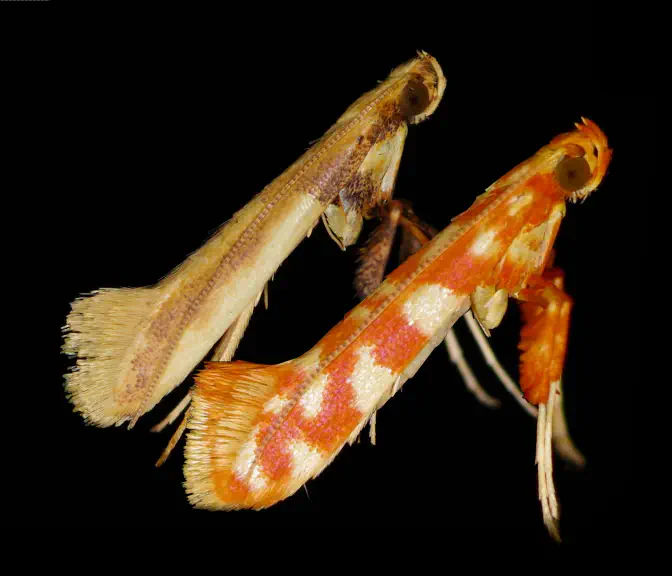 Image credit: [Antoine Guiguet]
Abstract
New Caledonia is a biodiversity hotspot with high levels of micro-endemism, yet its gracillariid fauna remains poorly documented. Here, two new species of Caloptilia Hübner, 1825 (Gracillariidae) are described from Glochidion J.R.Forst. & G.Forst. (Phyllanthaceae) host plants in Parc des Grandes Fougères, New Caledonia; Caloptilia augeas Guiguet, Lopez-Vaamonde, van Nieukerken & Ohshima, sp. nov., and Caloptilia ceryneia Guiguet, Lopez-Vaamonde, van Nieukerken & Ohshima, sp. nov. Both species induce leaf galls on Glochidion billardierei Baill., co-occurring on the same host species, sometimes even on the same leaf. They exhibit distinct wing patterns, but very similar male and female genitalia, and DNA barcoding supports their status as separate species. These findings provide evidence for potential within-host sympatric speciation, as documented in other gall-inducing insects. The larval biology of C. augeas and C. ceryneia reveals a unique frass disposal behaviour, whereby waste is excreted through a hole and the aperture is subsequently sealed—an adaptation not previously reported in gall-inducing Lepidoptera. Our findings double the known number of gall-inducing species in Gracillariidae, highlighting that this life history strategy may be more common than currently appreciated. We also provide new information on distribution and host plants of Caloptilia xanthopharella (Meyrick, 1880), a leaf roller found on the same host plant, G. billardierei. These findings mark the first records of the subfamily Gracillariinae in New Caledonia. This study underscores the underexplored diversity of New Caledonian gracillariids and emphasises the conservation value of Parc des Grandes Fougères. Further surveys in the Indo-Pacific region may reveal additional yet undescribed Caloptilia species associated with Phyllanthaceae and help clarify the evolutionary mechanisms underpinning their diversification.
Antoine Guiguet
Researcher and Curator for Hymenoptera
I am interested in the evolution and molecular ecology of plant-insect interactions.